Historic Technology Milestones

Each year, the IEEE Milestones program honors exceptional technical achievements that occurred at least 25 years ago. In 2024, 19 Milestones were dedicated, including:

Leading The Conversa

The Internet Turns 50

As the internet turned 50 in 2024, IEEE commemorated the revolutionary Transmission Control Protocol (TCP) that made it all possible. A special virtual event celebrated this milestone, featuring global leaders discussing the Internet’s impact. From its 1974 introduction in an IEEE paper to today’s network connecting over five billion people, TCP has enabled trillions of dollars in economic activity annually and sparked countless innovations.

1974

Transmission Control Protocol (TCP) Enables the Internet

Stanford, CA, USA
IEEE Life Fellows Vinton Cerf and Robert Kahn authored a seminal paper describing the Transmission Control Protocol (TCP) that supported the interconnection of multiple packet-switched networks into a network of networks. Split later into TCP and an Internet Protocol (IP), TCP and IP became core components of the Internet that DARPA launched operationally in 1983.
View highlights from the Internet Turns 50 Celebrations.

Other Milestone dedications included:

1969-1995

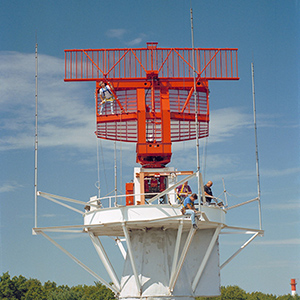
Mode S Air Traffic Control Radar Beacon System

Lexington, MA, USA In 1969, MIT Lincoln Laboratory began developing the Mode S selective secondary surveillance radar beacon system to enable safe air traffic control, and by 1995 it had become the worldwide standard for air traffic control radars.
Radio Tower
The rectangular Mode S array installed on top of a primary radar antenna.
1969-1995

1972-1987

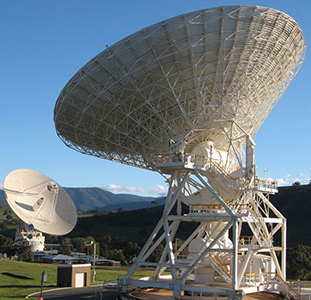
Deep Space Station 43

Paddy’s River District ACT, Australia Deep Space Station 43 is a steerable parabolic antenna that supported the Apollo 17 lunar mission, Viking Mars landers, Pioneer and Mariner planetary probes and Voyager’s encounters with Jupiter, Saturn, Uranus and Neptune.
Satellite Tower
DSS-43 and DSS-34, a 34-metre beam waveguide antenna
1972-1987

1997

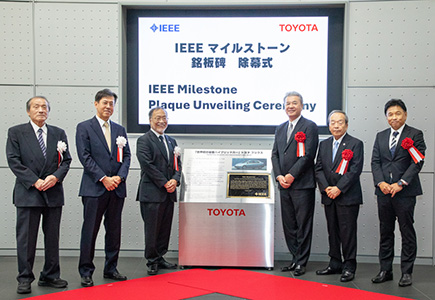
Toyota Prius, the World’s First Mass-Produced Hybrid Vehicle

Aichi, Japan Toyota Motor Corporation developed the world’s first mass-produced hybrid vehicle, the Toyota Prius, which used both an internal combustion engine and two electric motors. This vehicle achieved revolutionary fuel efficiency by recovering and reusing energy previously lost while driving, contributing to the reduction of CO2 emissions.
Plaque unveiling
Professor Isao Shirakawa (IEEE Japan Council History Committee Chair), Professor Jun Sato (IEEE Nagoya Section Chair), Professor Toshio Fukuda (2020 IEEE President), Hiroki Nakajima (VP, Toyota Motor Corp.), Takeshi Uchiyamada (Executive Fellow, Toyota Motor Corp.), and Takashi Uehara (President, Toyota Power Train Co.) at the milestone dedication.

1997

IEEE Milestones Program Celebrates 40th Anniversary

The IEEE Milestones Program marked its 40th anniversary, celebrating four decades of recognizing outstanding technical achievements across engineering, computing and science. Over these 40 years, the program has highlighted innovations that benefit humanity and has focused on honoring the achievement itself rather than specific places or people. From its first milestones in 1984 to today, the program has recognized over 250 significant technological contributions across the globe that have helped shape our world.